

Caribbean CBI in 2026 is more than a headline about longer queues or stricter rules. For high-net-worth families evaluating citizenship by investment (CBI), it’s a nuanced shift toward a more resilient, reputation-driven market. In our experience advising clients across the region, the core dynamics are clear: processing times have stretched, a backlog persists in varying degrees, and the governance framework across ECCIRA members has grown more sophisticated. Investors who plan ahead, work with experienced advisors, and align expectations with official requirements can still secure meaningful mobility and asset protection for their families. This post breaks down what has really changed in 2026 and what matters most for decision-making this year, with practical takeaways you can act on now. For context, the push toward tighter due diligence and post-approval obligations is not random—it’s increasingly aligned with EU, OECD, and FATF expectations, designed to safeguard long-term mobility. For more on Caribbean programs in general, see our overview of Caribbean citizenship pathways and the broader programs you should know. If you’re weighing global mobility options, our team can outline how these Caribbean paths compare with European golden visa or UAE routes for a comprehensive mobility strategy.
Why Processing Times Have Doubled Across Most Programs
Across the Caribbean CBI landscape, the typical processing window has lengthened to roughly eight to ten months, up from shorter historical ranges. The acceleration of compliance has been deliberate: mandatory applicant interviews from 2023, a region-wide expectation of 30-day residency in some models, escrow accounts for qualifying investments, biometric data collection, and a centralized database to prevent cross‑jurisdictional denials. These layers, codified in the 2024 Memorandum of Agreement and the 2025 ECCIRA framework, add rigorous checks at every stage. The result is a more thorough, but slower, pipeline that rewards transparent applicants and robust documentation. In our client work, we’ve seen the extra diligence reduce later surprises, even if it adds weeks or months to the timeline. For investor context, see IMI Daily’s analysis of 2026 processing dynamics and the role of tighter due diligence. IMI Daily — Processing Times 2026.
What’s new in 2026 is not just time; it’s the gearshift toward post‑approval governance. The emphasis on documentation, interviews, and post‑approval monitoring means ongoing investor oversight, not a single moment of execution. This is a shift that investors should embrace as a safeguard for long-term mobility—fewer denials, higher integrity, and better stability for family planning. Adeniyi Associates can help you map the timeline to your candidacy plan and your family’s needs.
Note: processing timelines vary by program and applicant profile. When you’re budgeting, build contingency for potential delays caused by peak volumes or regulatory updates. For a concise comparison of program timelines, see our St Kitts, St Lucia, and Dominica section below.
The Backlog Crisis: Which Programs Are Affected and Which Are Not
The backlog that appeared during 2022–23 from a surge of applicants, including non-traditional entrants, has not vanished. Grenada stood out by clearing a large backlog in 2024, then faced a temporary slowdown in 2025 due to a processing pause in August, while Antigua and Barbuda and Dominica continued to experience lingering delays. In 2025–26, the Eastern Caribbean Citizenship by Investment Regulatory Authority (ECCIRA) introduced ongoing diligence enhancements, further narrowing the pace of approvals in some periods. A consequential consequence is that programs with stronger pre‑approval screening and tighter post‑approval oversight tend to move more deliberately but with greater long-term resilience. For the latest regional trends, see IMI Daily’s coverage and state‑level updates from official CIU communications. IMI Daily — Processing Times.
Dominica’s approach has tightened in recent months, including tightened nationality filters and the suspension of new Iranian applicants in March 2026, with narrow exceptions. Separately, there have been notable enforcement actions—68 passports revoked since June 2024 for fraud or misrepresentation—an indicator that post‑approval diligence is now a central pillar of program integrity. These dynamics are not universal across all Caribbean programs; some have managed to reduce backlogs more quickly than others, but the trend across the region is clear: stricter, more methodical processing yields longer, more predictable timelines overall. For broader context on regulatory tightening, see industry analyses and official program statements summarized by credible sources. Immigrant Invest — Dominica Update.
St Kitts vs St Lucia vs Dominica — A Brutally Honest Comparison
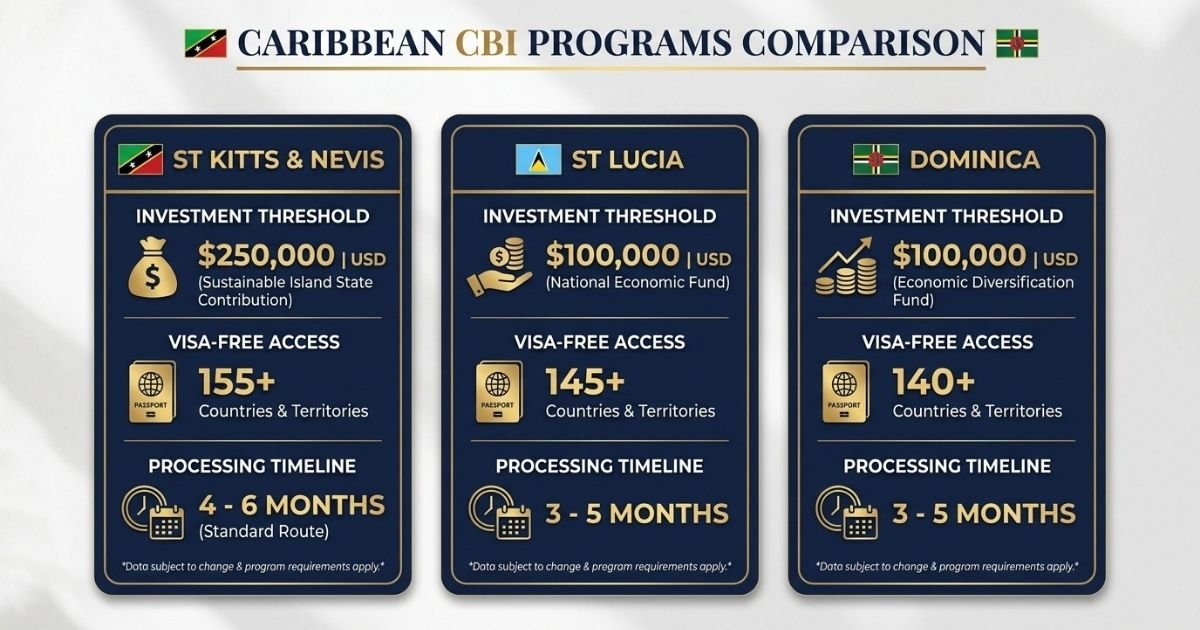
If you’re weighing which flagship Caribbean option fits your goals in 2026, the honest picture is that each program has evolved to serve different priorities: St Kitts and Nevis remains the benchmark for reputation and strict due diligence; St Lucia offers a balance of price and speed with a compelling value proposition; Dominica is the most affordable on a headline basis but has tightened eligibility and stricter post‑approval scrutiny. This trio is the core of the Caribbean Five, but they illustrate how the market is refining itself in response to international scrutiny and investor demand. For a longer, data‑driven comparison across programs, our team maintains a detailed analysis here: Caribbean Citizenship Programs and in our broader migration services content.
Below is a concise table to anchor your decision. It reflects the most common options investors consider when debating immediate cost versus long‑term mobility. The figures represent typical pathways acknowledged in industry literature and official program summaries. For exact numbers, consult the official CIU pages and your Adeniyi advisor before submitting an application.
| Program | Minimum Investment | Processing Time | Visa‑Free Countries | Key Benefit |
|---|---|---|---|---|
| St Kitts & Nevis | From $150,000 donation or $200,000 real estate | 8–10 months (typical) | 150+ countries | Strong passport reputation; rigorous due diligence |
| St Lucia | From $100,000 donation or $300,000 real estate | 8–10 months (typical) | 140–150 countries | Competitive pricing with relatively streamlined process |
| Dominica | From $100,000 donation or $200,000 real estate | 8–10 months (typical) | 130–140 countries | Most affordable headline option; growing family eligibility |
It’s important to note that any table like this is a snapshot. Processing times and minimums shift with regulatory changes and program policy updates. Investors should consider not just the upfront cost but the long‑term mobility and the program’s alignment with EU/OECD expectations, as these factors influence passport strength and future travel to business partners. For a tailored comparison, speak with our team at Adeniyi Associates and review official program pages before committing. If you’d like a deeper dive into how these options map to your family’s plans, read more in our benefits overview and schedule a consultation through Contact Us.
Why Stricter Due Diligence Is Actually Good News for Serious Investors
From where we sit, the push toward tighter due diligence is a good development for serious, long‑term mobility. The 68 passports revoked since June 2024 for fraud or misrepresentation signal that the system is cleaning its own house. For investors with transparent sources of funds and legitimate family profiles, the new standards translate into a more trustworthy investment‑migration market, better protection against abuse, and a higher likelihood that the passport will retain its value and visa access over time. In practice, this means more predictable outcomes for those who prepare thoroughly, maintain robust documentation, and engage experienced advisors who know how to navigate post‑approval obligations. This is not about adding friction for the sake of it; it’s about ensuring the programmatic integrity that underpins global mobility. For ongoing coverage of regulatory changes, see our companion analyses in the program overview and global mobility sections.
Investors should plan for a deliberate, well‑documented application path, including early due diligence reviews, clear source of funds, and a strategy for after-approval compliance. This approach reduces the risk of surprises, preserves visa‑free travel flexibility, and protects the family’s broader assets. If you’re unsure how to structure your plan, our team can design a timeline and budget that reflects your goals and risk tolerance—while staying on the right side of evolving international standards. To discuss your specific situation, reach out to Adeniyi Associates for a tailored roadmap.
Information accurate as of June 2026. Program rules change frequently — contact Adeniyi Associates for current guidance.