

Citizenship By Investment Updated Price guides are only useful when investors compare the headline contribution with the real all-in budget. In 2026, citizenship by investment remains a practical route for globally mobile families, but the market now ranges from ultra-low entry offers to established Caribbean programs and higher-ticket options with different travel profiles. Public program summaries from Henley & Partners and Immigrant Invest show that pricing can stretch from about $90,000 to $400,000+, before fees. If you are comparing options, our citizenship programs overview and second passport benefits pages are a useful starting point.
Citizenship By Investment Updated Price: what moved in 2026
Headline price versus all-in cost
The cheapest advertised number rarely tells the full story. Due diligence, family members, legal work, biometric steps, and passport issuance can all increase the total. Donation-based programs are usually simpler to budget for, while real-estate routes may look refundable but tie up capital and introduce resale risk. In our experience advising clients, the right question is not only, what is the minimum contribution? It is, what is the total cost to secure the passport that fits the family’s plans?
Why the low end has shifted
The current market floor has become more competitive in some niche jurisdictions. São Tomé and Príncipe is publicly marketed at $90,000+; Nauru has a limited-time offer at $95,000 through 30 June 2026. By contrast, the better-known Caribbean choices generally sit between $200,000 and $250,000. That spread makes value analysis more important than ever, especially for investors who want both mobility and a predictable process.
For a broader regional view, our Caribbean citizenship guide explains why many families still shortlist the Caribbean first, even when a cheaper headline price exists elsewhere.
2026 price comparison: direct citizenship programs
The table below compares the direct citizenship routes investors ask about most often. We have focused on programs with widely published public pricing and timeline data, because the real decision is usually made by balancing cost, speed, and travel value.
| Program | Minimum Investment | Processing Time | Visa-Free Countries | Key Benefit |
|---|---|---|---|---|
| São Tomé and Príncipe | $90,000+ | 2+ months | 60+ | Lowest entry point with no physical presence |
| Dominica | $200,000+ | 6+ months | 140+ | Strong value-to-price ratio and no residency requirement |
| Antigua and Barbuda | $230,000+ | 6+ months | 150+ | Broad family inclusion and a light visit rule |
| Grenada | $235,000+ | 8+ months | 140+ | US E-2 treaty access for eligible nationals |
| St Lucia | $240,000+ | 6+ months | 140+ | Flexible donation and real-estate routes |
| St Kitts and Nevis | $250,000+ | 4+ months | 150+ | Long-established program with strong passport profile |
| Egypt | $250,000+ | 10+ months | 60+ | Donation or real-estate path with regional appeal |
| Türkiye | $400,000+ | 3-4 months | 110+ | Fast route linked to a major real-estate market |
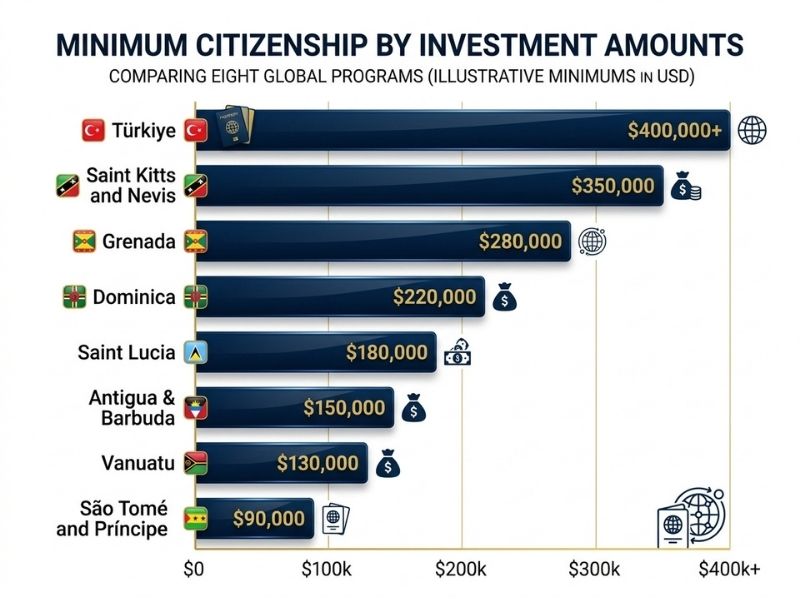
The visual makes one thing obvious: the cheapest entry price is not always the best overall fit. Investors should compare the minimum investment, the expected timeline, and the travel outcome together.
What the table does not show
Two programs can have the same headline price but very different practical costs. For example, one may allow a larger family at no extra minimum contribution, while another may charge more for parents, adult children, or siblings. Another may be faster, but only if the source-of-funds file is clean and complete. That is why an expert review matters before money is transferred.
How investors should compare value
Choose by outcome, not only price
Investors should begin with the end goal. If the priority is a low-friction passport with no residence requirement, donation routes often make the most sense. If the goal is business flexibility and exposure to a major market, Grenada’s US E-2 treaty can be a real advantage. If the priority is the lowest public entry point, São Tomé and Príncipe may be attractive, but the investor should still verify whether the passport supports the intended travel plan.
Family rules matter more than many applicants expect
Family inclusion can change the economics quickly. Some programs are generous with spouses, children, parents, grandparents, and even siblings. Others are tighter and may require more structuring. When families apply together, it is usually better to plan the full household from day one rather than add dependents later. If you want help deciding which structure is best, our investment migration services team can help, and you can always contact us for a tailored quote.

A second passport only creates value when it matches your mobility, family, and long-term planning goals.
Check the fine print before you commit
Before any application, investors should confirm the due diligence process, source-of-funds requirements, passport issuance steps, and whether the route is donation-based or real-estate-based. Real-estate programs can carry holding periods, resale limits, or completion risk. Donation routes are usually cleaner for clients who want certainty and speed. For a detailed consultation, our advisors can compare the current options side by side.
Frequently asked questions
Which program is the cheapest right now?
On current public pricing, São Tomé and Príncipe starts around $90,000, while Nauru’s limited-time offer is $95,000 through 30 June 2026. Investors should still compare travel access, family inclusion, and total fees before choosing.
Is the cheapest option the best value?
Not necessarily. A slightly higher-priced program may offer better visa-free access, a simpler file, or broader family eligibility. For many clients, Dominica, Antigua and Barbuda, Grenada, St Lucia, or St Kitts and Nevis are better long-term fits than the absolute lowest-price route.
How long does citizenship take?
Processing times vary by country and file quality, but public summaries show a range from about 2 months to 10+ months. The fastest routes are not always the simplest, so investors should budget time for due diligence as well as the main application.
What should I budget beyond the main contribution?
Plan for due diligence fees, government fees, passport or certificate issuance, legal and courier costs, and any extra charges for family members. If you choose a real-estate route, also include holding costs, closing fees, and exit conditions.
For investors comparing their Citizenship By Investment Updated Price options, the best strategy is to rank programs by value, not by the smallest headline number. The right passport should fit your family structure, mobility goals, and timeline, while keeping the process clear and defensible. If you want a personal comparison, our team can help you shortlist the most suitable options.
Information accurate as of May 2026. Program rules change frequently — contact Adeniyi Associates for current guidance.